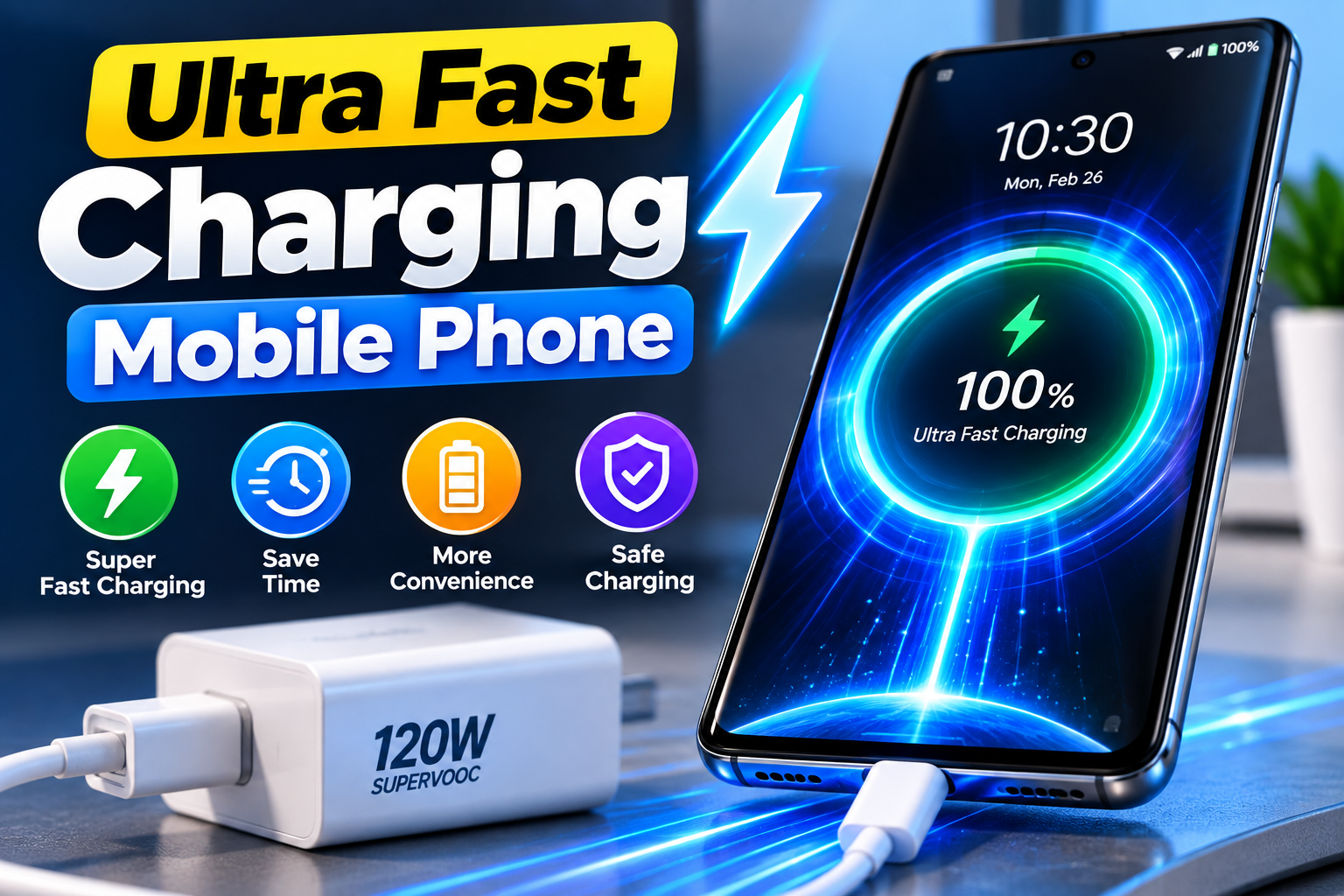
An Ultra-Fast Charging Mobile Phone offers a convenient solution by using advanced charging technology to restore battery power in less time than conventional charging systems. Depending on the smartphone model, compatible charger, and battery conditions, users can recharge a significant portion of their battery during a short break.
But how does ultra-fast charging work? Is it safe for your smartphone, and can it affect battery health? This guide explains the technology, its benefits, potential drawbacks, and what to consider before purchasing a fast-charging phone.
What Is an Ultra-Fast Charging Mobile Phone?
An ultra-fast charging mobile phone is a smartphone designed to support relatively high charging power. Unlike older devices that rely on lower-power charging systems, these smartphones can accept more power when used with compatible chargers and cables.
Depending on the manufacturer and model, smartphones may support charging capacities such as:
- 25W fast charging
- 45W fast charging
- 65W fast charging
- 80W fast charging
- 100W fast charging
- 120W or higher charging power
Higher wattage can reduce charging time, but it does not automatically guarantee better charging performance. Battery capacity, charging protocols, temperature, and the phone’s internal charging system also influence the final result.
How Does Ultra-Fast Charging Work?
Ultra-fast charging involves more than connecting a smartphone to a powerful adapter. The phone, charger, cable, battery, and charging-management system must work together to deliver power safely and efficiently.
The main components include:
- High-power charging adapter: Supplies electrical power at a supported voltage and current.
- Compatible charging cable: Transfers power between the charger and smartphone.
- Charging control hardware: Regulates the amount of power entering the device.
- Battery management software: Monitors charging conditions and helps manage battery performance.
- Thermal management system: Helps control temperature during charging.
The smartphone continuously monitors factors such as battery percentage, voltage, current, and temperature. It can adjust charging power as needed to manage heat and protect the battery.
Some smartphones also use dual-cell battery designs to distribute charging power more effectively. However, the specific implementation varies between manufacturers.
Major Benefits of Ultra-Fast Charging
Ultra-fast charging can be particularly useful for people who rely on their smartphones throughout the day.
1. Reduced Charging Time
The most obvious benefit is faster recharging. Some compatible smartphones can reach a substantial battery percentage in approximately 15–20 minutes under suitable conditions.
Actual charging times vary, so users should check independent tests and manufacturer specifications before comparing devices.
2. Convenience for Busy Users
If your battery is running low before work, school, or an appointment, a brief charging session may provide enough power for several additional hours of use.
This convenience can be valuable for people who regularly use their phones for communication, browsing, and productivity.
3. Useful During Emergencies
A short charging session can provide additional battery power for essential activities such as making calls, sending messages, or accessing navigation.
Although charging speed depends on several factors, having a fast-charging smartphone can reduce the time needed to regain useful battery capacity.
4. Better Convenience While Traveling
Travelers often have limited opportunities to recharge their devices. Ultra-fast charging can help reduce waiting time at airports, hotels, stations, and other locations where a power outlet is available.
5. Suitable for Heavy Smartphone Users
People who frequently use their phones for gaming, video recording, navigation, social media, and content creation may benefit from faster recharging throughout the day.
However, fast charging does not increase the battery’s total capacity or necessarily extend the phone’s overall battery life between charges.
Does Ultra-Fast Charging Damage Battery Health?
All rechargeable smartphone batteries gradually lose capacity as they age. This process is influenced by charging cycles, temperature, usage patterns, and the battery’s chemical characteristics.
Ultra-fast charging does not automatically mean a battery will deteriorate quickly. Modern smartphones incorporate charging controls designed to manage power delivery and temperature.
Common protective technologies include:
- Temperature sensors
- Voltage and current monitoring
- Adaptive charging controls
- Thermal management
- Software-based battery optimization
Heat is particularly important because prolonged exposure to high temperatures can accelerate battery aging. Smartphones may therefore reduce charging power when the device becomes hot or the battery approaches full capacity.
For better long-term battery health, avoid unnecessary heat, use compatible charging accessories, and follow the manufacturer’s recommendations.
Essential Safety Tips for Ultra-Fast Charging
Using high-power charging correctly can help reduce avoidable risks and maintain reliable performance.
Follow these precautions:
- Use the manufacturer’s recommended charger or a reputable compatible alternative.
- Choose a charging cable that supports the required power level.
- Avoid damaged, counterfeit, or poorly manufactured charging accessories.
- Keep the phone away from direct sunlight and other sources of excessive heat.
- Never place a charging phone under a pillow or blanket.
- Avoid intensive gaming or other demanding activities if the phone becomes unusually hot while charging.
- Keep the phone’s operating system updated when security and charging-related updates are available.
- Stop using a charger or cable if you notice unusual smells, visible damage, or abnormal heating.
These precautions are useful for all smartphones, not only devices with ultra-fast charging.
Ultra-Fast Charging vs. Standard Fast Charging
The term fast charging covers different power levels and technologies. A smartphone supporting 25W charging may recharge more slowly than a compatible device supporting 100W charging, but the difference depends on more than the advertised wattage.
| Feature | Standard fast charging | Ultra-fast charging |
|---|---|---|
| Typical advertised power | Around 18W–45W | Often 65W–120W or higher |
| Charging time | Varies by device | Can be shorter with compatible equipment |
| Charger requirements | Compatible fast charger | Charger and cable supporting the phone’s charging system |
| Heat management | Important | Especially important at higher power levels |
| Compatibility | Depends on the charging protocol | Depends on the phone, charger, cable, and protocol |
These wattage ranges are general descriptions, not universal industry standards. Manufacturers use different terminology, and some classify 45W charging as ultra-fast.
It is also important to understand that a smartphone rarely maintains its maximum advertised charging power throughout the entire charging process. Charging typically slows as the battery fills or when temperature limits are reached.
Which Smartphones Offer Ultra-Fast Charging?
Ultra-fast charging is available in several smartphone categories, although charging performance varies significantly between models.
You may find this feature in:
- Premium flagship smartphones
- Mid-range Android smartphones
- Gaming-focused mobile phones
- Performance-oriented devices
- Some foldable smartphones
Before purchasing a phone, check its official specifications and independent charging tests. Pay attention to the advertised time required to reach a particular battery percentage, rather than comparing wattage alone.
Also check whether the charger is included in the box. Some manufacturers sell compatible high-power chargers separately.
Should You Buy an Ultra-Fast Charging Phone?
Whether ultra-fast charging is worth paying for depends on your smartphone usage and priorities.
It may be a good choice if you:
- Use your smartphone heavily throughout the day.
- Frequently travel or work away from home.
- Play mobile games or record videos regularly.
- Need to recharge quickly between activities.
- Prefer shorter charging sessions instead of overnight charging.
Standard fast charging may be sufficient if you:
- Mainly use your phone for calls and messaging.
- Usually charge your device overnight.
- Rarely experience battery shortages.
- Prefer to prioritize other features over charging speed.
When comparing smartphones, consider charging performance alongside battery capacity, camera quality, processor speed, display quality, software support, durability, and price.
A phone with a larger battery and efficient processor may provide better overall endurance than a device with faster charging but higher power consumption.
The Future of Smartphone Charging Technology
Smartphone manufacturers continue to develop charging technologies that aim to improve convenience, efficiency, and battery longevity.
Important areas of development include:
- Advanced battery management: More sophisticated controls for charging efficiency and battery health.
- Improved thermal management: Better ways to regulate heat during high-power charging.
- Wireless charging improvements: Faster and more convenient charging without a physical cable.
- Intelligent charging optimization: Software that adapts charging behavior to usage patterns and battery conditions.
- Next-generation battery technologies: Research into alternative battery materials and designs, including solid-state batteries.
These developments may improve future smartphones, although their availability, cost, and practical benefits will depend on technological progress and commercial adoption.
Conclusion
Ultra-fast charging has made smartphones more convenient by reducing the time needed to restore battery power. By combining compatible chargers, suitable cables, charging-control hardware, and battery-management systems, modern devices can deliver significantly faster charging than many older smartphones.
However, advertised wattage alone does not determine the overall experience. Real charging performance depends on the smartphone’s design, battery capacity, temperature, charging protocol, and other conditions.
For the best results, choose a device that matches your daily needs, use reliable charging accessories, and avoid excessive heat. Ultra-fast charging can be a valuable feature when convenience matters, but it should be considered alongside battery endurance, reliability, and overall smartphone performance.
Frequently Asked Questions
What is an ultra-fast charging mobile phone?
It is a smartphone that supports relatively high charging power, allowing its battery to recharge faster than many conventional charging systems when compatible equipment is used.
Is ultra-fast charging safe?
Generally, yes, when the phone and charging accessories are compatible, undamaged, and used according to the manufacturer’s instructions.
Can ultra-fast charging affect battery health?
Battery capacity naturally declines over time. High temperatures and charging conditions can influence the rate of battery aging, so effective thermal management and appropriate charging habits are important.
Can I use a regular charger with an ultra-fast charging phone?
In most cases, yes. However, charging will generally be slower, and some chargers may not support the phone’s preferred charging protocol.
Is 45W considered ultra-fast charging?
It depends on the manufacturer. There is no universal industry threshold separating fast charging from ultra-fast charging.
Does a 120W charger always deliver 120W to a phone?
No. Actual charging power depends on the phone’s supported charging system, battery percentage, temperature, cable, charger compatibility, and other conditions.
Is a higher-wattage charger always better?
No. The smartphone must support the relevant charging technology to benefit from higher power. A compatible charger with appropriate safety protections is more important than wattage alone.
Can I use my phone while it is charging?
Yes, under normal conditions. However, demanding activities such as intensive gaming can generate additional heat, which may slow charging and contribute to battery aging over time.
Related topic: Explore the differences between 4G and 5G smartphones.